Skip to content

    Russian Verbs of Motion

    Russian distinguishes going on foot (идти/ходить) from going by vehicle (ехать/ездить), then asks whether a journey is in one direction, habitual, or viewed as a whole visit. Prefixes add arrival, departure, entry, and more. Start with the short decision framework, then use the interactive diagrams below to see these differences in action: switch between journeys, choose a prefix, and press Play to watch the movement. Keep the forms handy, compare real journeys, then bring the ideas together in the visual summary before practice.

    Russian verbs of motion: choose in three steps

    Choose in three steps: mode, direction, then aspect. Russian verbs of motion distinguish how you travel and whether you describe one directed journey, repeated trips, or movement in several directions.

    1. How are you moving?

    On foot: идти / ходить. By vehicle: ехать / ездить. For flying, swimming, carrying, or leading, choose the corresponding pair below.

    2. What kind of movement is it?

    One journey in a direction, currently under way or scheduled: идти / ехать. A habit, movement in various directions, or a past visit viewed as a whole: ходить / ездить.

    3. Do you need an endpoint or a completed event?

    This is a separate aspect choice. All four unprefixed verbs above are imperfective. Learn an actual prefixed aspect pair for arrival or departure, such as приехать / приезжать; a single direction alone does not make a verb perfective.

    Directional vs multidirectional motion verbs

    Direction is not aspect: идти, ходить, ехать, ездить are all imperfective. A prefix can add a route or endpoint, but do not assume the perfective and imperfective partners are formed mechanically. Learn each actual pair below. Then try these choices in the interactive diagrams.

    See how motion verbs work: interactive diagrams
    Choose a direction or prefix, then press Play to watch the journey. See how going one way, making repeated trips, arriving and leaving change the verb you need. Explore six verb families and ten prefixes, then check your understanding with a short quiz.

    On foot

    идти́

    A specific journey on foot

    By transport

    е́хать

    A specific journey by transport

    One journey in progressThe route runs one way from home toward work. It illustrates direction, not a claim of completed arrival.HOMEWORK

    One journey in progress

    The route runs one way from home toward work. It illustrates direction, not a claim of completed arrival.

    Static route. Play once to follow the traveler.

    In context

    Сейча́с я иду́ на рабо́ту.

    I’m walking to work right now.

    A single ongoing journey uses directional идти / ехать.

    Important: идти́, ходи́ть, е́хать, е́здить are all imperfective. Direction and grammatical aspect are separate distinctions.

    Text reference: both directions, six families and ten prefixes

    Direction is not aspect

    Идти́, ходи́ть, е́хать, е́здить are all imperfective. Direction and grammatical aspect are separate distinctions.

    One direction: идти́ / е́хать

    A single ongoing journey uses directional идти / ехать.

    Сейча́с я иду́ на рабо́ту.

    I’m walking to work right now.

    Diagram: One journey in progress. The route runs one way from home toward work. It illustrates direction, not a claim of completed arrival.

    Repeated / multidirectional: ходи́ть / е́здить

    Habitual, round-trip or non-directional movement uses multidirectional ходить / ездить.

    Ка́ждый день я хожу́ на рабо́ту.

    I walk to work every day.

    Diagram: Trips back and forth or habitual travel. The route goes from home to work and back, illustrating repeated, round-trip or multidirectional movement.

    Six verb families

    Walking

    идти́ · directional

    to walk in one direction

    Я иду́ домо́й.

    I am walking home.

    Diagram: Directional movement. A single route leads from a starting point toward a target.

    ходи́ть · multidirectional

    to walk habitually or around

    Я ча́сто хожу́ пешко́м.

    I often walk on foot.

    Diagram: Multidirectional movement. The route leads toward a target and back toward the starting point. Wearing glasses is a habitual meaning of носить, not a literal trip along this route.

    Transport

    е́хать · directional

    to travel by transport in one direction

    Мы е́дем в го́род.

    We are travelling into town.

    Diagram: Directional movement. A single route leads from a starting point toward a target.

    е́здить · multidirectional

    to travel habitually or around

    Мы ча́сто е́здим в го́род.

    We often travel into town.

    Diagram: Multidirectional movement. The route leads toward a target and back toward the starting point. Wearing glasses is a habitual meaning of носить, not a literal trip along this route.

    Running

    бежа́ть · directional

    to run along one route

    Он бежи́т в парк.

    He is running to the park.

    Diagram: Directional movement. A single route leads from a starting point toward a target.

    бе́гать · multidirectional

    to run habitually or around

    Он бе́гает ка́ждое у́тро.

    He runs every morning.

    Diagram: Multidirectional movement. The route leads toward a target and back toward the starting point. Wearing glasses is a habitual meaning of носить, not a literal trip along this route.

    Flying

    лете́ть · directional

    to fly along one route

    Самолёт лети́т в Ри́гу.

    The plane is flying to Riga.

    Diagram: Directional movement. A single route leads from a starting point toward a target.

    лета́ть · multidirectional

    to fly habitually or around

    Я ча́сто лета́ю в Ри́гу.

    I often fly to Riga.

    Diagram: Multidirectional movement. The route leads toward a target and back toward the starting point. Wearing glasses is a habitual meaning of носить, not a literal trip along this route.

    Swimming / sailing

    плыть · directional

    to swim or sail in one direction

    Ло́дка плывёт к бе́регу.

    The boat is moving toward shore.

    Diagram: Directional movement. A single route leads from a starting point toward a target.

    пла́вать · multidirectional

    to swim or sail habitually or around

    Она́ пла́вает в бассе́йне.

    She swims in the pool.

    Diagram: Multidirectional movement. The route leads toward a target and back toward the starting point. Wearing glasses is a habitual meaning of носить, not a literal trip along this route.

    Carrying

    нести́ · directional

    to carry on foot in one direction

    Я несу́ су́мку домо́й.

    I am carrying a bag home.

    Diagram: Directional movement. A single route leads from a starting point toward a target.

    носи́ть · multidirectional

    to carry or wear habitually

    Я ношу́ очки́.

    I wear glasses.

    Diagram: Multidirectional movement. The route leads toward a target and back toward the starting point. Wearing glasses is a habitual meaning of носить, not a literal trip along this route.

    Ten motion prefixes and aspect pairs

    The large prefixed form is perfective: it presents a bounded event as a whole, not necessarily an event already completed. Perfective can describe a past event or a future one: Завтра я приду́ домо́й ра́но. (Tomorrow I will arrive home early.) The imperfective partner can describe repeated events or movement in progress.

    при- · Arrive

    To arrive on foot. Toward a destination.

    On foot (perfective / imperfective):
    прийти́ / приходи́ть
    By transport (perfective / imperfective):
    прие́хать / приезжа́ть

    Я пришёл домо́й.

    I arrived home.

    Diagram: Arrive at the destination. A traveler moves from a starting point to home, stopping at the destination.

    у- · Leave

    To leave on foot. Away from a starting point.

    On foot (perfective / imperfective):
    уйти́ / уходи́ть
    By transport (perfective / imperfective):
    уе́хать / уезжа́ть

    Она́ ушла́ с рабо́ты.

    She left work.

    Diagram: Leave the starting point. A traveler leaves home and moves beyond a dashed boundary, away from the starting point.

    в-/во- · Enter

    To enter on foot. Moving inward.

    On foot (perfective / imperfective):
    войти́ / входи́ть
    By transport (perfective / imperfective):
    въе́хать / въезжа́ть

    Он вошёл в ко́мнату.

    He entered the room.

    Diagram: Cross the threshold into the room. A traveler starts outside, passes through the doorway at x=282, and ends inside the room.

    вы- · Exit

    To exit on foot. Moving outward.

    On foot (perfective / imperfective):
    вы́йти / выходи́ть
    By transport (perfective / imperfective):
    вы́ехать / выезжа́ть

    Мы вы́шли из до́ма.

    We went out of the house.

    Diagram: Cross the threshold to the outside. A traveler starts inside the house, passes through the doorway at x=306, and ends outside.

    под- · Approach

    To approach on foot. Moving closer.

    On foot (perfective / imperfective):
    подойти́ / подходи́ть
    By transport (perfective / imperfective):
    подъе́хать / подъезжа́ть

    Я подошёл к две́ри.

    I approached the door.

    Diagram: Get closer to the target. A traveler moves toward a target but stops near it, without entering or passing through it.

    от-/ото- · Move away

    To move away on foot. Increasing distance.

    On foot (perfective / imperfective):
    отойти́ / отходи́ть
    By transport (perfective / imperfective):
    отъе́хать / отъезжа́ть

    Он отошёл от окна́.

    He moved away from the window.

    Diagram: Increase the distance. A traveler starts near a reference point and moves farther away from it.

    пере- · Cross

    To cross on foot. From one side to another.

    On foot (perfective / imperfective):
    перейти́ / переходи́ть
    By transport (perfective / imperfective):
    перее́хать / переезжа́ть

    Она́ перешла́ у́лицу.

    She crossed the street.

    Diagram: Cross to the other side. A traveler crosses the street on a pedestrian crossing, moving from side A to side B.

    до- · Reach

    To reach a point on foot. Reaching the endpoint.

    On foot (perfective / imperfective):
    дойти́ / доходи́ть
    By transport (perfective / imperfective):
    дое́хать / доезжа́ть

    Мы дошли́ до па́рка.

    We reached the park on foot.

    Diagram: Go as far as the endpoint. A traveler moves up to a finish line and stops at that limit.

    про- · Pass through

    To pass through on foot. Moving past or through.

    On foot (perfective / imperfective):
    пройти́ / проходи́ть
    By transport (perfective / imperfective):
    прое́хать / проезжа́ть

    Мы прошли́ че́рез парк.

    We walked through the park.

    Diagram: Pass through and continue. A traveler starts before a park, walks through it, and continues beyond its far edge.

    за- · Drop by

    To drop in on foot. Making a stop or detour.

    On foot (perfective / imperfective):
    зайти́ / заходи́ть
    By transport (perfective / imperfective):
    зае́хать / заезжа́ть

    Я зашёл в магази́н.

    I dropped by the shop.

    Diagram: Stop by, then continue. A traveler leaves the main route to visit a shop, then rejoins the route and continues.
    Russian verbs of motion: the eight main pairs

    After exploring the diagrams, keep these pairs together — never learn one without the other. Use the conjugations below as your tense reference.

    Идти vs ходить: walking

    Идти describes walking in one direction; ходить describes habitual or multidirectional walking and can describe a single past visit. Я иду в школу. — “I’m walking to school.” Я хожу в школу каждый день. — “I go to school every day.” Вчера я ходил в музей. — “Yesterday I visited the museum.”

    Ехать vs ездить: travel by transport

    Ехать and ездить make the same distinction by vehicle: one directed journey versus habitual, multidirectional travel or a past visit. Я еду на работу. — “I’m on my way to work by transport.” Я езжу на работу на автобусе. — “I take the bus to work.”

    to go on foot
    иду / ходишь
    Unidirectional
    идти
    idti
    Multidirectional
    ходить
    khodit'

    The most common pair. Идти focuses on one journey in a direction; ходить covers habits, movement in several directions, or a past visit viewed as a whole.

    to go by vehicle
    еду / ездишь
    Unidirectional
    ехать
    yekhat'
    Multidirectional
    ездить
    yezdit'

    Used for car, bus, train, taxi — any wheeled or rail transport (not flying or sailing).

    to run
    бегу / бегаешь
    Unidirectional
    бежать
    bezhat'
    Multidirectional
    бегать
    begat'

    Бежать is irregular (бегу, бежишь, бегут).

    to fly
    лечу / летаешь
    Unidirectional
    лететь
    letet'
    Multidirectional
    летать
    letat'

    Used for both aircraft and birds.

    to swim / sail
    плыву / плаваешь
    Unidirectional
    плыть
    plyt'
    Multidirectional
    плавать
    plavat'

    Used for people swimming and for boats sailing.

    to carry (on foot)
    несу / носишь
    Unidirectional
    нести
    nesti
    Multidirectional
    носить
    nosit'

    For carrying something while walking. Носить also means 'to wear' (clothes).

    to transport (by vehicle)
    везу / возишь
    Unidirectional
    везти
    vezti
    Multidirectional
    возить
    vozit'

    For transporting cargo or people in a vehicle.

    to lead / take (a person)
    веду / водишь
    Unidirectional
    вести
    vesti
    Multidirectional
    водить
    vodit'

    Also: водить машину = 'to drive a car' (you 'lead' the car).

    Russian motion verb conjugation: present and past forms

    The four everyday go verbs have forms worth learning separately: я иду, я хожу, я еду, and irregular я езжу (not ездю).

    Present forms follow я, ты, он/она, мы, вы, они. In the past, choose masculine, feminine, neuter, or plural to match the subject.

    идти
    on foot, one direction
    я иду
    ты идёшь
    он/она идёт
    мы идём
    вы идёте
    они идут
    masculineшёл
    feminineшла
    neuterшло
    pluralшли
    ходить
    on foot, habitual / multidirectional
    я хожу
    ты ходишь
    он/она ходит
    мы ходим
    вы ходите
    они ходят
    masculineходил
    feminineходила
    neuterходило
    pluralходили
    ехать
    by vehicle, one direction
    я еду
    ты едешь
    он/она едет
    мы едем
    вы едете
    они едут
    masculineехал
    feminineехала
    neuterехало
    pluralехали
    ездить
    by vehicle, habitual / multidirectional
    я езжу
    ты ездишь
    он/она ездит
    мы ездим
    вы ездите
    они ездят
    masculineездил
    feminineездила
    neuterездило
    pluralездили

    Past tense: шёл and ехал vs ходил and ездил

    Идти has irregular past forms шёл, шла, шло, шли. Я шёл домой. — “I was walking home.” Я ехал домой. — “I was traveling home by transport.” Neither asserts arrival. Я ходил в театр. / Я ездил в театр. — “I visited the theater” on foot / by transport. Ходил and ездил also describe habits: Я ездил туда каждую неделю. — “I went there every week.”

    Talking about the future

    A future habit and a particular departure are different meanings, not interchangeable “future forms” of one verb. Imperfective буду идти / буду ехать can also focus on a journey in progress at a future time.

    Perfective future приду describes a future arrival, not something already completed: Я приду завтра. — “I’ll come tomorrow.” Perfective aspect presents that future event as a whole.

    Я буду ходить на работу пешком.

    I will walk to work regularly.

    Imperfective compound future for a future habit (буду + ходить).

    Я пойду домой после урока.

    I will set off home on foot after class.

    Perfective future of пойти: a particular departure on foot.

    Я поеду домой после урока.

    I will set off home by vehicle after class.

    Perfective future of поехать: a particular departure by vehicle.

    Завтра я еду в Москву.

    Tomorrow I'm going to Moscow by vehicle.

    The present of ехать can describe a scheduled journey.

    See Russian verb tenses for more future forms.

    Пошёл vs ходил: one journey, arrival, visit, or habit?

    Now put the forms in context: follow the same trip to the shop through four different viewpoints.

    Пошёл means “set off on foot”: it is the perfective onset of movement, not arrival. Он пошёл в магазин. — “He set off for the shop.” Ходил is imperfective and can describe a past visit or habit: Он ходил в магазин вчера. — “He visited the shop yesterday.” A finished visit in context does not make the verb perfective.

    шёл

    Я шёл в магазин, когда начался дождь.

    I was walking to the shop when it began to rain.

    The outward journey was in progress; this says nothing about arrival or return.

    пришёл

    Я пришёл в магазин в десять.

    I arrived at the shop at ten.

    A completed arrival on foot, not simply movement toward the shop.

    ходил

    Вчера я ходил в магазин.

    Yesterday I went to the shop.

    A past visit viewed as a whole; a there-and-back reading is usual in this context, but the verb alone does not guarantee that the speaker returned.

    хожу

    Я хожу в магазин каждую субботу.

    I go to the shop every Saturday.

    A recurring habit, not one trip under way now.

    Ходил / ездил often suggests a completed visit and return in everyday contexts, but that is a contextual inference, not an encoded guarantee. Шёл / ехал describes the outward journey without asserting arrival. For в/на destinations, see Russian prepositions.

    Russian verbs of motion with prefixes

    Move from the journey itself to arrival, departure, and other routes. Learn each prefixed verb with its actual aspect partner.

    Add a route meaning with prefixes. A prefix does not always mean perfective: приходить and приезжать are prefixed imperfectives. Prefixes can mark arrival, departure, entry, and other routes. They do not create aspect pairs by a universal prefix rule: learn the actual verbs, including stem changes such as приехать / приезжать and уехать / уезжать.

    по-to set off; start moving
    Он пошёл домой.
    He set off home / He went home.
    при-to arrive
    Поезд пришёл вовремя.
    The train arrived on time.
    у-to leave; go away
    Она уехала в Москву.
    She left for Moscow.
    в- / во-to enter; go into
    Он вошёл в комнату.
    He entered the room.
    вы-to exit; go out
    Я вышел из дома.
    I went out of the house.
    до-to reach; get as far as
    Мы дошли до парка.
    We reached the park (on foot).
    за-to drop in; stop by
    Я зашёл к другу.
    I dropped in on a friend.
    пере-to cross; move across
    Он перешёл улицу.
    He crossed the street.
    про-to pass through / past
    Мы прошли мимо магазина.
    We walked past the shop.

    Arrival and departure: learn the actual aspect pairs

    A completed event versus repeated events, with the direction and starting point made explicit.

    Прийти / приходить is an actual perfective / imperfective pair. Он пришёл вчера. — “He arrived yesterday” (one whole arrival). Он приходил каждый день. — “He came every day” (repeated visits). Приходил can also describe a single past visit, without focusing on the moment of arrival.

    приехать (perfective) / приезжать (imperfective)

    Он приехал в Москву вчера.

    He arrived in Moscow by vehicle yesterday.

    Он приезжает в Москву каждый месяц.

    He comes to Moscow by vehicle every month.

    уехать (perfective) / уезжать (imperfective)

    Он уехал из Москвы утром.

    He left Moscow by vehicle in the morning.

    Он уезжает из Москвы каждую пятницу.

    He leaves Moscow by vehicle every Friday.

    прийти (perfective) / приходить (imperfective)

    Она пришла домой.

    She arrived home on foot.

    Она приходит домой в шесть.

    She usually comes home at six.

    Он вошёл в комнату. / Он входил в комнату тихо.

    He entered the room. / He was entering the room quietly. (в-/во-)

    Она перешла улицу. / Она переходила улицу каждый день.

    She crossed the street. / She crossed the street every day. (пере-)

    See how aspect works and how it changes future tense.

    Carry, transport, or accompany?

    Apply the same choices when you move something or accompany someone. First decide whether the object moves with you on foot, in a vehicle, or as a person you lead. Then choose one trip (нести / везти / вести) or a habitual/multidirectional action (носить / возить / водить).

    нести / носить

    Я несу сумку домой.

    I'm carrying a bag home on foot.

    несу: one direction on foot.

    везти / возить

    Я везу сумку в машине.

    I'm transporting a bag in the car.

    везу: one trip by vehicle.

    вести / водить

    Я веду ребёнка в школу.

    I'm leading a child to school on foot.

    веду: accompanying and leading a person on foot.

    везти / возить

    Я везу ребёнка в школу на машине.

    I'm taking a child to school by car.

    везу: transporting a person in a vehicle.

    The thing or person moved is the direct object in the accusative: сумку (from сумка), ребёнка (animate masculine accusative, which looks like the genitive). See the accusative case.

    Bring the choices together: a visual summary

    You have seen the journeys, forms, and prefixes. Use this overview to connect them before choosing a practice drill.

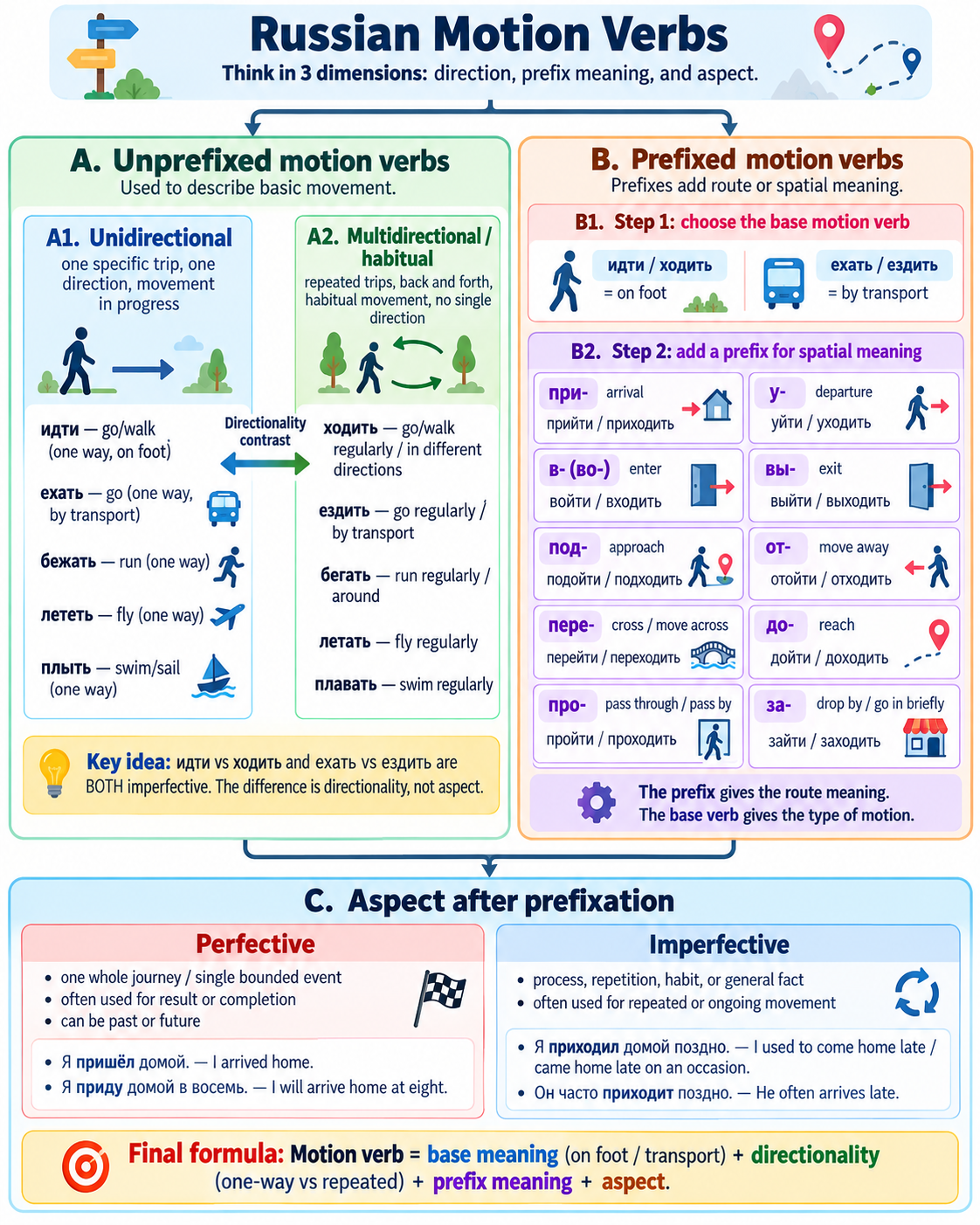
    Russian motion verbs infographic: unprefixed directionality, prefix route meanings, and aspect after prefixation.

    Read A for unprefixed movement, B for the route a prefix adds, and C for aspect. The final formula brings these decisions together as a study aid.

    Open full-size image (opens in a new tab)

    The same overview in words

    Start with the movement and direction
    On foot, choose идти / ходить; by vehicle, ехать / ездить. Both members of each unprefixed pair are imperfective. One-direction movement can be past, present, or future, not only something happening now. Multidirectional forms cover habits and movement in different directions; ходил can also describe one past visit, with no repetition required. Review the decision framework or compare journey viewpoints.
    Add the route meaning, then learn the actual pair
    Prefixes specify arrival (при-), departure (у-), entry (в-/во-), exit (вы-), and other routes. Learn pairs such as прийти / приходить and приехать / приезжать rather than attaching pieces mechanically. Explore prefixes and aspect pairs.
    Choose aspect and the tense your sentence needs
    Perfective presents a bounded event, often its completion; imperfective can present a process, repetition, habit, or general fact. Compare шёл (was walking), ходил (went for a visit), пришёл (arrived), and приходил (came on an occasion). Context matters: imperfective does not always mean “repeated.” Perfective has past and future forms, not a present-tense meaning. Check conjugations and tense examples.

    Russian verbs of motion exercises

    Practice the distinction you need. Choose a drill for the decision you just learned, then try the complete exercise collection.

    Where motion verbs fits in Russian grammar

    Place motion-verb pairs alongside aspect, prefixes, tense, and sentence structure in the complete Russian grammar guide.

    Read the full Russian grammar guide